The three power forms
The exam gives you two of {voltage, current, resistance} and wants power. Pick the form that uses what you were given:
400 VDC across 800 ohms. Voltage and resistance, so P = E²/R = 160000/800 = 200 watts.
12 VDC, 0.2 amperes. Voltage and current, so P = E × I = 2.4 watts.
7.0 mA through 1250 ohms. Current and resistance, so P = I²R = (0.007)² × 1250 = 0.061 W = 61 milliwatts.
Convert to base units first — amps, volts, ohms — and back only at the end. The milliampere in that last one is where the mistakes happen.
RMS, again, and why it is the one that matters
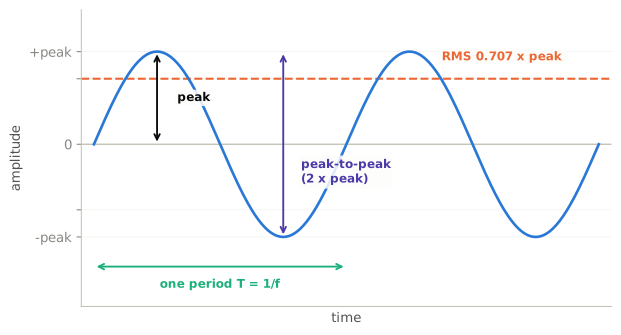
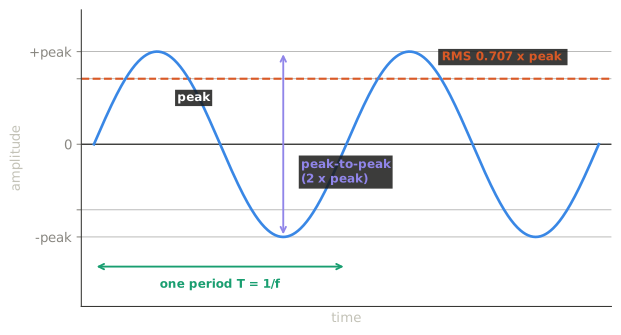
What value of an AC signal produces the same power dissipation in a resistor as a DC voltage of the same value?
The RMS value.
That is the definition of RMS, and it is why every power calculation uses it. For a sine wave:
Two conversions the pool asks directly:
RMS 120 V → peak-to-peak? peak = 120 × 1.414 = 169.7; peak-to-peak = 2 × 169.7 = 339.4 volts.
Peak 17 V → RMS? 17 × 0.707 = 12 volts.
PEP, in the five shapes the exam uses
Peak envelope power is the average power during one RF cycle at the crest of the modulation envelope. Every PEP question is one of these.
Peak-to-peak voltage into a known load
Two steps: peak-to-peak → RMS (divide by 2, then by √2), then RMS → power.
200 V peak-to-peak into 50 ohms: RMS = 200 / 2 / 1.414 = 70.7 V; P = 70.7² / 50 = 100 watts.
500 V peak-to-peak into 50 ohms: RMS = 176.8 V; P = 176.8² / 50 = 625 watts.
Power into a known load, backwards to voltage
1200 W into a 50-ohm dummy load: √(1200 × 50) = √60000 = 245 volts RMS.
An unmodulated carrier
What is the ratio of PEP to average power for an unmodulated carrier?
1.00.
What is the output PEP of an unmodulated carrier if the average power is 1060 watts?
1060 watts.
A steady carrier has no envelope to peak — its amplitude never changes, so peak and average are the same number. This is the reason a 100 W carrier and a 100 W PEP SSB signal are very different things in practice: the SSB signal’s average power is a fraction of its PEP, while the carrier’s is all of it.
Decibels
What dB change represents a factor of two increase or decrease in power?
Approximately 3 dB.
The anchor from the foundations track, unchanged. And one General-level refinement:
What percentage of power loss is equivalent to a loss of 1 dB?
20.6 percent.
One decibel is a factor of 10^(−0.1) = 0.794, so 79.4% gets through and 20.6% is lost. Worth knowing because feed-line loss is quoted in decibels per hundred feet, and “only 1 dB” turns out to be a fifth of your power.
Parallel currents
How does the total current relate to the individual currents in a circuit of parallel resistors?
It equals the sum of the currents through each branch.
Same voltage across each branch, currents add. The complement of the series rule, where the current is common and the voltages add.
Check yourself
- What is the PEP of a signal showing 100 V peak-to-peak on a scope across a 50-ohm load?
- Your feed line is rated at 2 dB loss. What fraction of your power reaches the antenna?
- An unmodulated carrier reads 500 W average. What is its PEP?
Answers
- RMS = 100 / 2 / 1.414 = 35.4 V; P = 35.4² / 50 = 25 watts.
- 2 dB is two 1 dB losses: 0.794 × 0.794 = 0.63, so about 63% arrives — a third of your power gone. (Equivalently, 10^(−0.2).)
- 500 W. For an unmodulated carrier, PEP equals average power.