Reactance, precisely
What is reactance?
Opposition to the flow of alternating current caused by capacitance or inductance.
Note that the pool asks the same thing three ways — “opposition to AC in an inductor”, “opposition to AC in a capacitor”, “what is reactance” — and the answer is reactance every time. It is measured in ohms and represented by the letter X.
The two formulas, and the behaviour that follows:
How does an inductor react to AC?
As the frequency of the applied AC increases, the reactance increases.
How does a capacitor react to AC?
As the frequency of the applied AC increases, the reactance decreases.
Frequency is in the numerator for the inductor and the denominator for the capacitor. Everything else about tuned circuits, filters, and matching follows from that one asymmetry.
Worked: a 1 µH inductor at 7.15 MHz has X_L = 2π × 7.15×10⁶ × 1×10⁻⁶ = 45 ohms. A 100 pF capacitor at 14.2 MHz has X_C = 1 / (2π × 14.2×10⁶ × 100×10⁻¹²) = 112 ohms.
Neither is negligible, which is why stray inductance and capacitance matter at RF in a way they never do at audio.
Impedance
What is impedance?
The ratio of voltage to current.
That is the general definition, and it holds whether the opposition is resistance, reactance, or both. Ohm’s law with Z in place of R.
What is the term for the inverse of impedance?
Admittance.
Admittance (Y) is to impedance what conductance is to resistance — the reciprocal. It simplifies parallel circuits for the same reason conductance does: admittances add in parallel.
Impedance matching
Which of the following devices can be used for impedance matching at radio frequencies?
All these choices are correct — a transformer, a Pi-network, and a length of transmission line.
Three different mechanisms, one purpose:
- A transformer transforms impedance by the square of its turns ratio.
- A Pi-network uses reactances to transform between impedances, and is the classic output network in a tube amplifier.
- A length of transmission line transforms impedance along its length; a quarter-wave section is the standard trick, transforming Z to Z₀²/Z.
Resonance
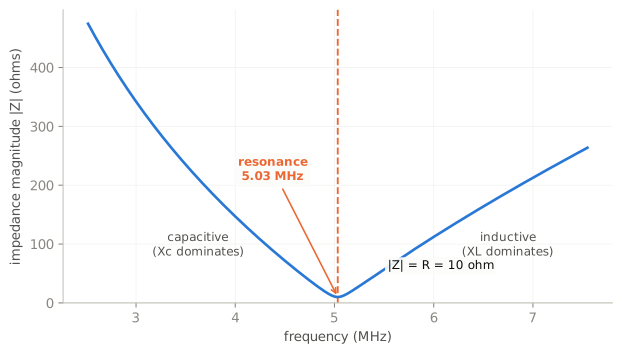
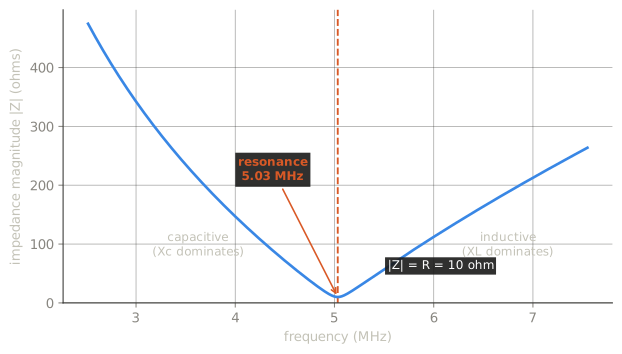
What occurs in an LC circuit at resonance?
Inductive reactance and capacitive reactance cancel.
Where that formula comes from — two lines of algebra
Nothing here is beyond the two reactance formulas you already have. Resonance is defined as the frequency where they are equal, so set them equal and solve:
\quad\Longrightarrow\quad f = \frac{1}{2\pi\sqrt{LC}}$$ Taking the positive root because frequency is a magnitude. The formula is not a separate fact to memorise — it is $X_L = X_C$ rearranged, and if you forget it you can rebuild it in about fifteen seconds. **A consequence worth having.** Substitute that $f$ back into either reactance and the $2\pi$ and the square roots collapse: $$X_L\big|_{f_0} = 2\pi\left(\frac{1}{2\pi\sqrt{LC}}\right)L = \sqrt{\frac{L}{C}}$$ So at resonance both reactances equal $\sqrt{L/C}$ — a quantity that depends on the **ratio** of L to C, not on their product. Two circuits can resonate at the same frequency (same $LC$) while presenting wildly different reactances (different $L/C$). That is the difference between a high-impedance tank and a low-impedance one, and it is why you cannot specify a tuned circuit by its frequency alone. *Both statements above are re-proved symbolically on every build; see the derivation on the [glossary entry](/glossary/#resonant-frequency).* </details> The circuit that algebra describes, with each element's contribution to the total impedance named:  Written as a complex sum, the whole of the above is one line: $$Z = R + j\left(2\pi f L - \frac{1}{2\pi f C}\right)$$ Resonance is the frequency that kills the imaginary part. Everything else in this lesson — why series shorts and parallel opens, why Q sets bandwidth — is a consequence of that expression. The resonant frequency is the same for series and parallel — but the *behaviour* is opposite: > **What happens when inductive and capacitive reactance are equal in a series > LC circuit?** > **Resonance causes impedance to be very low.** **Series resonance: minimum impedance.** The two reactances cancel in the series total, leaving only the (usually small) resistance. **Parallel resonance: maximum impedance.** The cancellation removes the paths for current instead. If you remember one sentence: **series shorts, parallel opens.** **Worked:** 10 µH with 100 pF resonates at f = 1 / (2π√(10×10⁻⁶ × 100×10⁻¹²)) = **5.03 MHz**. ## Check yourself 1. A capacitor's reactance at 7 MHz is 100 ohms. What is it at 14 MHz? 2. A series LC circuit is at resonance. Is its impedance high or low, and what is the current doing? 3. What is admittance? <details> <summary>Answers</summary> 1. **50 ohms.** Capacitive reactance is inversely proportional to frequency, so doubling the frequency halves it. 2. **Low** impedance, **maximum** current. Series resonance leaves only the resistance. 3. **The inverse of impedance.** </details>