Forget the channel numbers for ten minutes
Your radio shows channels 1 to 22. The FCC’s rules contain no such numbering — §95.1763 lists frequencies, in four groups, and the group a frequency belongs to determines its power limit, its bandwidth, and which kinds of station may transmit on it.
Learning the four groups makes the channel numbers fall out for free. Learning the channel numbers teaches you nothing about the rules.
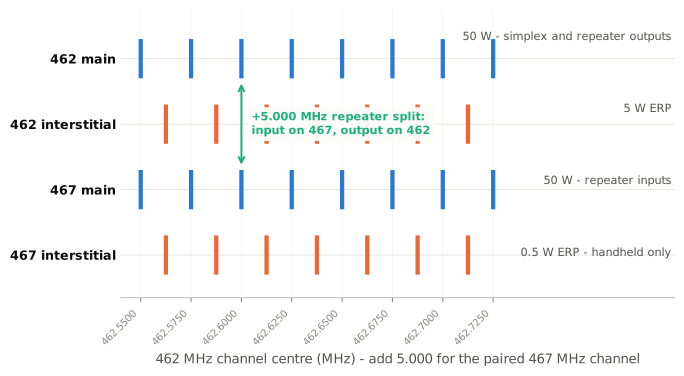
The four groups
The GMRS is allotted 30 channels — 16 main channels and 14 interstitial channels. — 47 CFR 95.1763
| Group | Count | Spacing | Power limit | Who may transmit |
|---|---|---|---|---|
| 462 MHz main | 8 | 25 kHz | 50 W (15 W fixed) | mobile, hand-held, repeater, base, fixed |
| 462 MHz interstitial | 7 | offset 12.5 kHz | 5 W ERP | mobile, hand-held, base |
| 467 MHz main | 8 | 25 kHz | 50 W (15 W fixed) | mobile, hand-held, control, fixed — through a repeater only |
| 467 MHz interstitial | 7 | offset 12.5 kHz | 0.5 W ERP | hand-held only |
The 462 MHz main channels run 462.5500 to 462.7250 in 25 kHz steps. The interstitials sit exactly between them: 462.5625, 462.5875, and so on. The 467 MHz groups repeat the same pattern 5.000 MHz higher.
What each group is actually for
462 MHz main — the eight channels that matter. Full 50 W, any station type, usable simplex or as a repeater output. If you are having a conversation on GMRS, you are almost certainly on one of these.
462 MHz interstitial — the shared low-power channels. Capped at 5 W ERP. These are the frequencies FRS radios use, so this is where you talk to a neighbour’s bubble-pack radio.
467 MHz main — repeater inputs, not conversation channels. A mobile or hand-held station may transmit here only when working through a repeater, or for brief test transmissions. Setting a radio to simplex on 467.6000 is legal for a test and useless for a chat, because nobody is listening there.
467 MHz interstitial — half a watt, hand-helds only. These are the FRS “channels 8 to 14” that everyone wonders about. The limit is 0.5 W ERP for a reason: they were allotted for very short-range use.
Bandwidth
The authorized bandwidth is 20 kHz for … the 462 MHz main channels, the 467 MHz main channels, and the 462 MHz interstitial channels, and 12.5 kHz for … the 467 MHz interstitial channels. — 47 CFR 95.1773
In practice that maps onto the “wide/narrow” switch on a radio. The 467 MHz interstitials must be narrow; everything else may be wide. Peak deviation limits follow the same split: ±5 kHz on the wide channels, ±2.5 kHz on the 467 MHz interstitials (§95.1775).
The numbering, since your radio uses it
The 1–22 numbering is a manufacturer convention that predates the current rules. Roughly:
- Channels 1–7 are the 462 MHz interstitials — shared with FRS, 5 W.
- Channels 8–14 are the 467 MHz interstitials — 0.5 W, hand-held only.
- Channels 15–22 are the 462 MHz main channels — the full-power ones.
- Repeater channels, often labelled 15R–22R or 23–30, pair a 467 MHz main input with the 462 MHz main output 5.000 MHz below.
Treat these as a convenience, not as the rule. When two sources disagree about what “channel 19” means, the frequency settles it and the number does not.
The habit to build
When you pick a channel, ask the three questions the rules ask:
- Which group is this frequency in? That gives you the power limit.
- What kind of station am I? Hand-held, mobile, base, fixed, repeater — the permitted set differs per group.
- Simplex or through a repeater? On 467 MHz main, only the second is permitted for mobile and hand-held stations.
Check yourself
- You are running a 40 W mobile. On which channels may you use that power?
- A radio is transmitting 5 W on 467.6625 MHz. What is wrong?
- Why is a conversation on 467.5500 MHz simplex a bad idea even where it is technically permitted?
Answers
- The 462 MHz main channels (and the 467 MHz main channels when working through a repeater), which permit 50 W. The interstitials cap you at 5 W ERP or 0.5 W ERP.
- 467.6625 is a 467 MHz interstitial: 0.5 W ERP, hand-held units only. 5 W exceeds the limit by ten times.
- 467 MHz main channels are repeater inputs. Mobile and hand-held stations may transmit there only through a repeater or for brief tests, and nobody monitors them for conversation — so even where a fixed or control station might, the traffic goes nowhere.