What a decibel is
A decibel compares two powers:
It is always a ratio. “My antenna has 6 dB” is incomplete — 6 dB compared with what? Suffixes supply the missing reference: dBi compares with an isotropic radiator, dBd with a dipole, dBm with one milliwatt, dBW with one watt.
The logarithm exists because it turns multiplication into addition. A signal path that multiplies by 100, then by 0.5, then by 4 becomes +20, −3, +6 dB, which you add in your head to +23 dB.
The three anchors
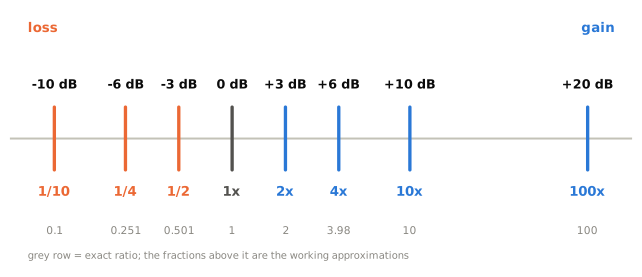
Memorise exactly three facts:
| Change | In dB |
|---|---|
| Power doubles | +3 dB |
| Power halves | −3 dB |
| Power ×10 | +10 dB |
From those:
- ×4 is ×2 twice, so +6 dB
- ×8 is ×2 three times, so +9 dB
- ×20 is ×10 then ×2, so +13 dB
- ×100 is ×10 twice, so +20 dB
- ÷4 is −6 dB, ÷100 is −20 dB
That is enough to answer every decibel question in the Technician and General pools without arithmetic beyond addition.
The pool’s questions, solved
A power increase from 5 watts to 10 watts. The ratio is 2. Power doubled, so +3 dB.
A power decrease from 12 watts to 3 watts. The ratio is 1/4 — halved, then halved again. −3 −3 = −6 dB.
A power increase from 20 watts to 200 watts. The ratio is 10, so +10 dB.
Every one of these is “work out the ratio, then decompose it into 2s and 10s.”
The coefficient trap
The 10 in the formula is for power ratios. For voltage or current ratios into the same impedance, the coefficient is 20:
The two are consistent, not contradictory: power goes as voltage squared, and the square comes out of the logarithm as a factor of two. The practical consequence is that doubling voltage is +6 dB, while doubling power is +3 dB. Mixing these up is the most common decibel error there is.
Why this matters more than it looks
Once you can add decibels, a whole class of station questions becomes trivial. A 100 watt transmitter, 2 dB of feed-line loss, and a 7 dBd beam:
+7 − 2 = +5 dB net, so the effective radiated power is about three times the transmitter output — roughly 300 watts ERP. No multiplication required.
The same reasoning explains why buying more power is usually a poor investment. Going from 100 W to 200 W is +3 dB. Received signal strength is conventionally reported in S-units of about 6 dB each, so that doubling is half an S-unit — often invisible on the other end. Fixing 2 dB of feed-line loss and adding 6 dB of antenna gain buys you more than a linear amplifier does, and it works on receive too.
Check yourself
- A power change from 100 W to 25 W. How many dB?
- An amplifier turns 5 W into 500 W. How many dB of gain?
- Voltage across a load doubles. How many dB is that?
Answers
- Ratio 1/4 = halved twice = −6 dB.
- Ratio 100 = ×10 twice = +20 dB.
- Voltage ratio, so the coefficient is 20: +6 dB.