Two families of modulation
Every analogue voice mode does one of two things to a carrier.
Amplitude modulation varies the carrier’s strength with the audio. Single sideband is a form of amplitude modulation — the pool asks this directly. SSB is AM with the carrier and one sideband removed, which is why it fits in a third of the space and puts all the power into information.
Frequency modulation varies the carrier’s frequency with the audio. FM and its close relative PM (phase modulation) are what VHF and UHF voice repeaters use, and what VHF packet radio uses.
The bandwidth table
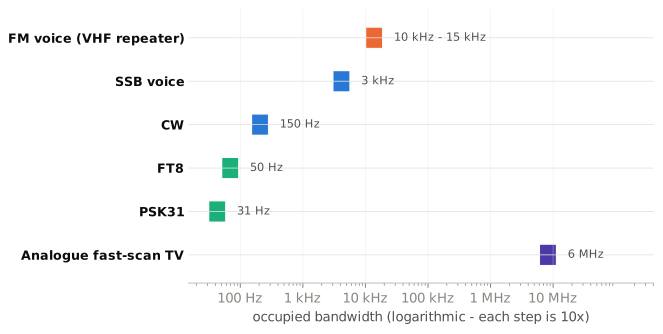
| Mode | Approximate bandwidth |
|---|---|
| CW | 150 Hz |
| SSB voice | 3 kHz |
| FM voice (VHF repeater) | between 10 and 15 kHz |
| AM fast-scan TV | about 6 MHz |
Four numbers, all asked directly. CW has the narrowest bandwidth of the signal types in the pool.
The scale is worth feeling rather than memorising. One fast-scan television signal is about 6 MHz wide — the entire 2 metre band is 4 MHz. A single analogue TV transmission would not fit in it.
Why SSB for weak signals
Which type of voice mode is often used for long-distance (weak signal) contacts on the VHF and UHF bands?
SSB.
Two reasons, and they compound:
Narrower bandwidth means less noise. A receiver’s noise power is proportional to its bandwidth. An SSB receiver taking in 3 kHz admits roughly a quarter of the noise an FM receiver taking in 12 kHz does — about 6 dB of free sensitivity.
FM has a threshold and SSB does not. An FM signal below the receiver’s threshold does not get quieter, it disappears into noise. An SSB signal just gets weaker, and a human ear pulls speech out of noise remarkably far down.
What is one characteristic of single sideband (SSB) compared to FM?
SSB signals have narrower bandwidth.
Which sideband
Which sideband is normally used for 10-meter HF, VHF, and UHF single-sideband communications?
Upper sideband.
Convention, not rule. USB above 10 MHz and on VHF/UHF; LSB on 160, 80, and 40 metres. Nobody remembers why; everybody follows it, and using the wrong one makes your voice unintelligible rather than merely different.
Where FM wins
FM is not the poor relation — it dominates local operating for good reasons. Constant amplitude makes it immune to the impulse noise that plagues AM, and receivers are simple and cheap. Its distinctive property is the capture effect: when two signals arrive together, the stronger one wins completely.
Which of the following is a disadvantage of FM compared with single sideband?
Only one signal can be received at a time.
That is the capture effect stated as a cost. On SSB you hear two stations overlapping and can work through it; on FM the weaker one simply vanishes. On a busy repeater that is a feature — no mush, just whoever is strongest. In a contest or an emergency net where several stations need to be heard, it is a liability.
Choosing, in practice
| Situation | Mode |
|---|---|
| Local contact through a repeater | FM |
| Distant VHF contact, weak signal | SSB, horizontally polarised |
| Weakest possible signal, any distance | CW or a digital mode |
| Data over VHF | FM with a packet or digital modem |
Check yourself
- Rank CW, FM voice, and SSB voice by bandwidth, narrowest first.
- Why does SSB reach further than FM at the same power?
- Two stations transmit on the same FM repeater input at once. What does the repeater retransmit?
Answers
- CW (150 Hz), SSB (3 kHz), FM (10–15 kHz).
- Narrower bandwidth admits less receiver noise — about 6 dB — and SSB degrades gracefully below the point where FM drops out entirely.
- The stronger one, alone. That is the capture effect; only one signal is received at a time.