The short version
A Technician gets all amateur privileges above 50 MHz — the whole of 6 metres, 2 metres, 1.25 metres, 70 centimetres, and everything above — plus four narrow slices of HF, only one of which permits voice.
The VHF and UHF privileges are the point of the licence. The HF slices are a taste of what General opens up.
HF: four segments, one voice privilege
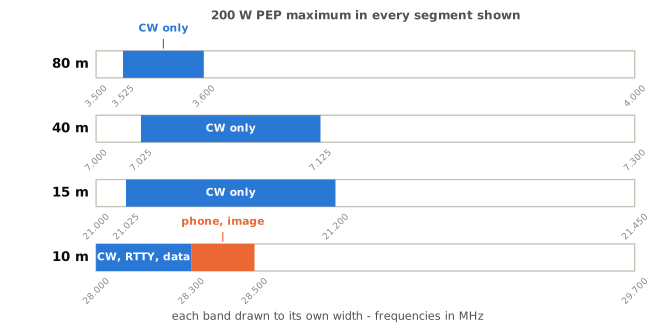
| Band | Segment | Modes |
|---|---|---|
| 80 m | 3.525 – 3.600 MHz | CW only |
| 40 m | 7.025 – 7.125 MHz | CW only |
| 15 m | 21.025 – 21.200 MHz | CW only |
| 10 m | 28.000 – 28.300 MHz | CW, RTTY, data |
| 10 m | 28.300 – 28.500 MHz | phone and image |
Two facts the pool asks in several forms:
- The only Technician HF phone privilege is 28.300 to 28.500 MHz, on the 10 metre band.
- Technician HF segments are limited to 200 watts PEP (§97.313(c)(2)). Everywhere else, the general amateur limit of 1500 watts PEP applies.
Ten metres is worth caring about. It is a band that opens spectacularly at solar maximum, and a Technician with 200 W and a simple antenna works the world on it when conditions cooperate.
VHF and UHF: everything, with two CW-only edges
Above 50 MHz a Technician holds full privileges. The band edges to know:
- 6 m: 50 – 54 MHz. 50.0 – 50.1 MHz is CW only.
- 2 m: 144 – 148 MHz. 144.0 – 144.1 MHz is CW only.
- 1.25 m: 222 – 225 MHz
- 70 cm: 420 – 450 MHz
Which of the following VHF/UHF band segments are limited to CW only?
50.0 MHz to 50.1 MHz and 144.0 MHz to 144.1 MHz
Those two 100 kHz slices exist to protect weak-signal work at the bottom of each band from wideband FM. They are worth memorising as a pair.
Some frequency anchors the pool uses:
- 52.525 MHz is in the 6 metre band — the national FM simplex calling frequency there.
- 146.52 MHz is in the 2 metre band — the national FM simplex calling frequency, and the single most-quoted number in amateur radio.
SSB phone may be used in at least some segment of every amateur band above 50 MHz. Not the whole band, but somewhere in each — usually just above the CW segment.
Digital modes
Technicians may use digital modes on all of their bands. The pool’s question about which bands include Technician digital privileges answers “all these choices are correct”. On HF the digital segment is 28.000 – 28.300 MHz; above 50 MHz, digital is permitted where the band plan puts it.
The International Space Station
Any amateur with a Technician class or higher licence may contact the ISS. There is no additional endorsement and no higher class required. The crew operates an ordinary amateur station, and a handheld with a decent antenna genuinely reaches it on a good pass.
Related: the control operator of a station communicating through an amateur satellite may be any amateur allowed to transmit on the satellite’s uplink frequency. The privilege follows the uplink, not the downlink.
Primary and secondary allocations
Some amateur allocations are secondary: another service holds the band primarily, and amateurs use it on the condition of not interfering.
How are US amateurs restricted in segments of bands where the Amateur Radio Service is secondary?
U.S. amateurs may find non-amateur stations in those segments, and must avoid interfering with them
This is not a technicality. On 70 centimetres, amateurs are secondary to government radiolocation across much of the band. Hearing something that is not an amateur station there means moving, not complaining.
Why you should not sit on the band edge
Why should you not set your transmit frequency to be exactly at the edge of an amateur band or sub-band?
All these choices are correct.
The three reasons, and they all matter:
- Your sidebands extend beyond your carrier frequency. A dial reading of 144.000 MHz on SSB puts energy below 144.000 — outside the band.
- Your frequency display may be slightly inaccurate. Consumer transceivers are typically specified to a few parts per million, which at 440 MHz is hundreds of hertz.
- Your signal occupies bandwidth. An FM signal is roughly 16 kHz wide; the dial number is its centre, not its edge.
The practical habit: stay a few kilohertz inside the edge on SSB and CW, and further inside on FM. Nobody has ever been cited for being 5 kHz too polite.
Check yourself
- You want to make an HF voice contact as a Technician. Where, and at what maximum power?
- Name two reasons not to set an FM transmitter’s dial to exactly 146.000 MHz.
- Which of 52.525 MHz and 146.52 MHz is on 6 metres?
Answers
- 28.300 – 28.500 MHz on 10 metres, at up to 200 W PEP.
- Any two of: an FM signal is about 16 kHz wide and the dial shows its centre, so half of it sits below; the display itself is accurate only to a few parts per million; and sidebands extend either side of the carrier. (146.000 is inside the band, so this one is about occupied bandwidth rather than legality — but at 144.000 the same three reasons put you outside it.)
- 52.525 MHz. 146.52 MHz is the 2 metre simplex calling frequency.