What a schematic shows
What is an electrical diagram using standard component symbols called?
Schematic.
Which of the following is accurately represented in electrical schematics?
Component connections.
Connections — and nothing else. A schematic does not show physical placement, wire lengths, or the size of anything. Two components drawn adjacent may be at opposite ends of a chassis; a long wire may be a short line. What the schematic promises is which terminal joins which.
The three pool diagrams
Twelve of the T6 questions point at three figures published with the pool. They are worth opening now and coming back to, because the questions ask nothing more than “what is component n”.
Figure T-1 — a simple transistor circuit.
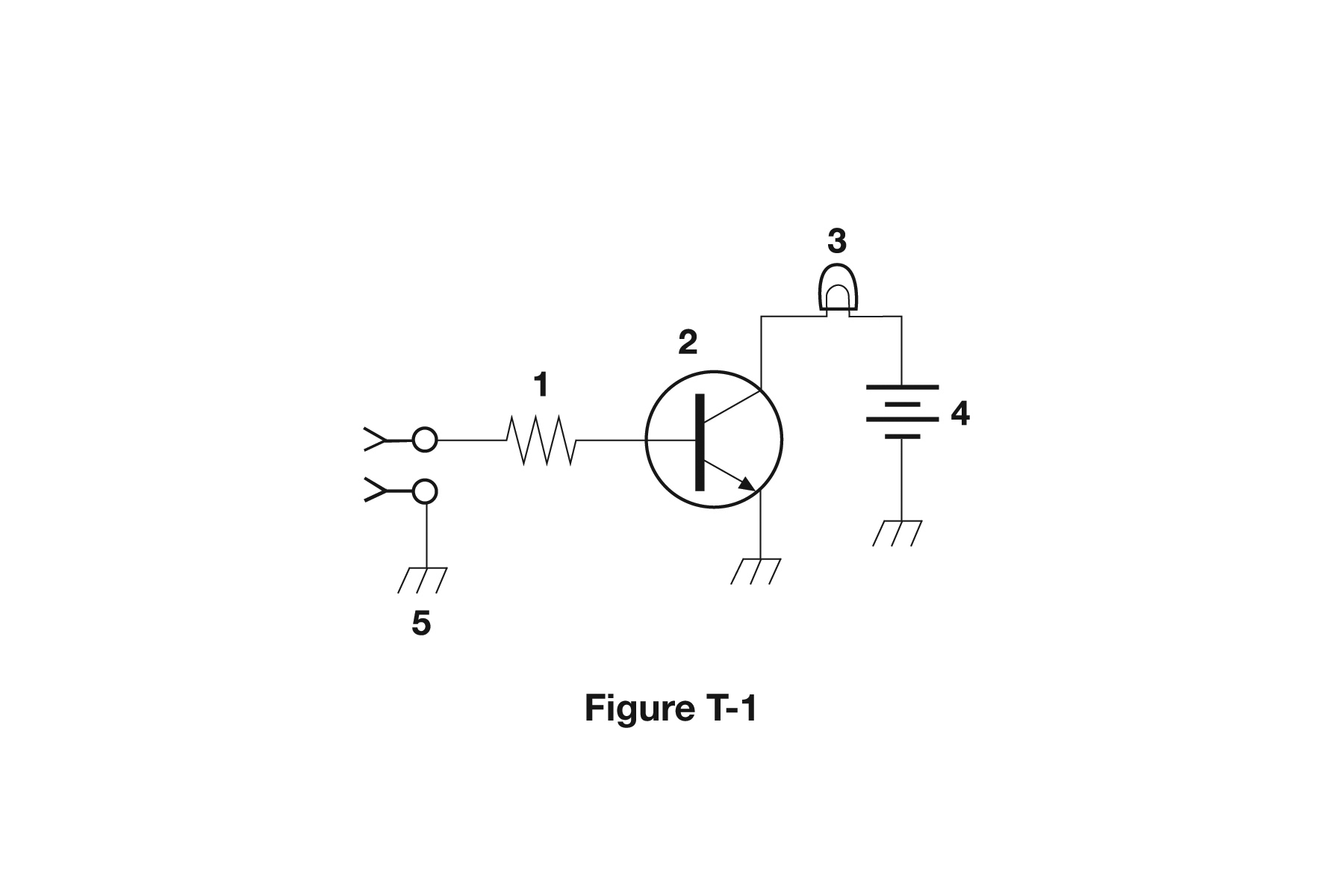
| Component | What it is |
|---|---|
| 1 | Resistor |
| 2 | Transistor |
| 3 | Lamp |
| 4 | Battery |
And a function question on the same figure: the function of component 2 (the transistor) is to control the flow of current.
Figure T-2 — a power supply.
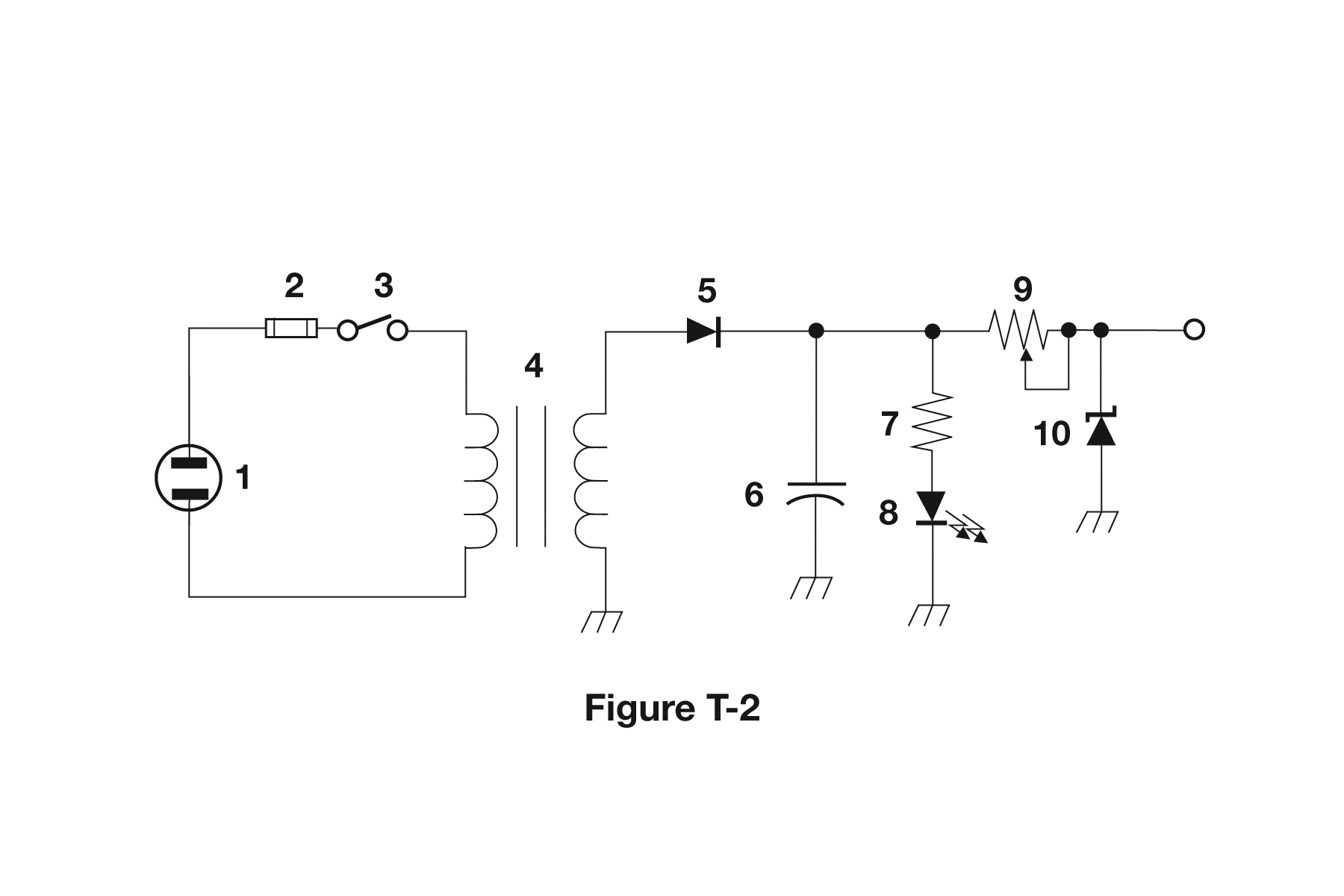
| Component | What it is |
|---|---|
| 3 | Single-pole single-throw switch |
| 4 | Transformer |
| 6 | Capacitor |
| 8 | Light-emitting diode |
| 9 | Variable resistor |
Figure T-3 — a tuned circuit feeding an antenna.
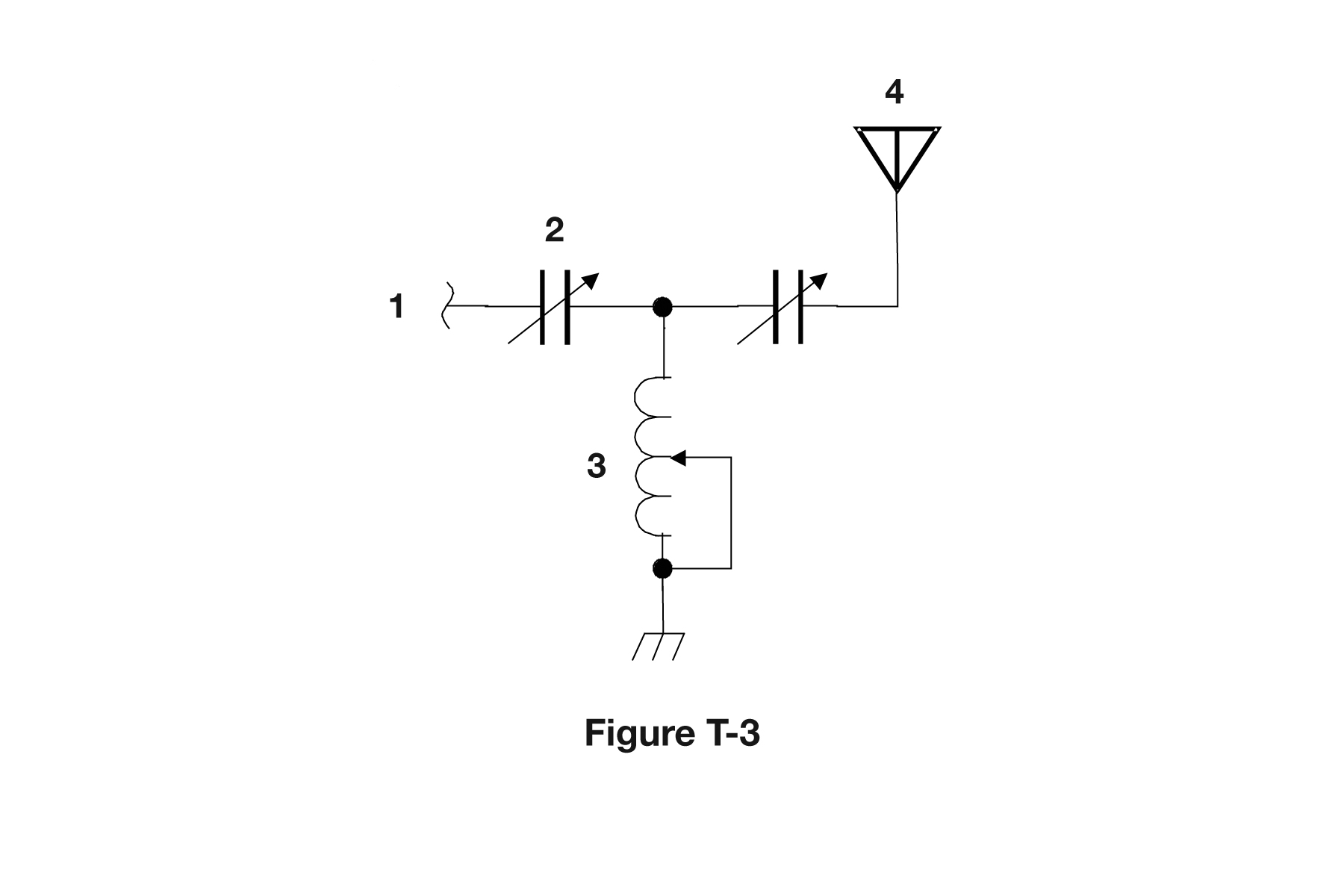
| Component | What it is |
|---|---|
| 3 | Variable inductor |
| 4 | Antenna |
The symbols worth recognising on sight
Rather than memorising numbered components, learn the shapes:
- Resistor — zigzag (US) or plain rectangle (IEC).
- Capacitor — two parallel lines; one curved line means polarised.
- Inductor — a series of loops; a bar alongside means a core.
- Variable anything — an arrow through the symbol.
- Transformer — two coils facing each other, usually with core bars between.
- Diode — triangle pointing into a bar; the bar is the cathode, matching the stripe on the physical part.
- LED — a diode with two arrows radiating away.
- Transistor — a circle with three leads; the arrow’s position and direction says which type.
- Antenna — a stylised whip or a triangle.
- Battery — alternating long and short lines.
- Ground — a descending stack of shortening horizontal lines.
Learn these ten and you can read the diagrams without knowing which numbered component the question means.
Naming the blocks
The other half of this material is functional: given a job, name the circuit.
| Job | Block |
|---|---|
| Change AC into varying (pulsating) DC | Rectifier |
| Control the amount of voltage from a power supply | Regulator |
| Change 120 V AC to a lower AC voltage | Transformer |
| An electrically-controlled switch | Relay |
| Display an electrical quantity as a numeric value | Meter |
| A visual indicator | LED |
| Several semiconductors and other components in one package | Integrated circuit |
Two distinctions the pool leans on:
Rectifier versus regulator. A rectifier makes DC out of AC, and what comes out is lumpy — pulsating DC. A regulator holds the level steady. A power supply usually has both, plus filter capacitors between them, and each does a different job.
Transformer versus regulator. A transformer changes AC voltage and cannot change DC at all. A regulator controls DC output. Confusing them is the most common error in this group.
Resonant circuits
Which of the following is combined with an inductor to make a resonant circuit?
Capacitor.
Which of the following is a resonant or tuned circuit?
An inductor and a capacitor in series or parallel.
Straight from the foundations lesson: two opposite reactances that cancel at one frequency. Series or parallel — both are resonant circuits, and they behave oppositely, which is exactly why the answer includes both.
Shielded wire
Which of the following is a reason to use shielded wire?
To prevent coupling of unwanted signals to or from the wire.
Note to or from. A shield keeps interference out of a sensitive line and keeps RF in on a transmitting one. In a station both directions matter, and the same cable often needs both.
Check yourself
- Your power supply outputs 13.8 V but it sags badly under load. Rectifier or regulator?
- On a schematic, what does an arrow drawn through a component mean?
- What two components make a tuned circuit, and in what arrangements?
Answers
- The regulator — its job is holding the level steady. A failing rectifier shows as excessive ripple or no output at all.
- That the component is variable or adjustable.
- An inductor and a capacitor, in series or parallel.