One carrier, three things you can change
A sine-wave carrier has exactly three properties available to modulate, and each gives its own family of modes.
| Change this | Get this |
|---|---|
| instantaneous power level | amplitude modulation |
| instantaneous frequency | frequency modulation |
| phase angle | phase modulation |
The pool asks each of these directly, in those words. Worth having verbatim.
And one implementation detail asked as its own question:
What emission is produced by a reactance modulator connected to a transmitter RF amplifier stage?
Phase modulation.
A reactance modulator varies a reactance in the oscillator or amplifier circuit, which shifts phase. FM and PM are closely related — FM is the integral of PM — and this is why the pool routinely pairs them as “FM or PM”.
Digital modulation
How is direct binary FSK modulation generated?
By changing an oscillator’s frequency directly with a digital control signal.
Frequency shift keying in its simplest form: two frequencies, one per bit. The two are named:
How are the two separate frequencies of a Frequency Shift Keyed (FSK) signal identified?
Mark and space
What type of modulation is used by FT8?
8-tone frequency shift keying.
Eight tones rather than two, so each symbol carries three bits.
What is QPSK modulation?
Modulation in which digital data is transmitted using 0-, 90-, 180- and 270-degrees phase shift to represent pairs of bits
Quadrature phase shift keying: four phase states, two bits per symbol. And QPSK31 — the pool answers “all these choices are correct” — is used for keyboard-to-keyboard on HF, has a 31 Hz bandwidth, and its forward error correction is exactly what distinguishes it from plain PSK31.
Bandwidth
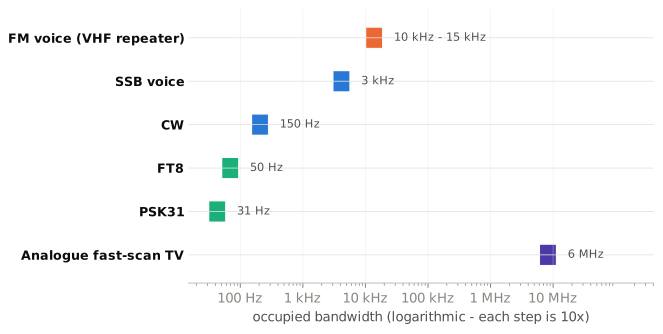
Which of the following phone emissions uses the narrowest bandwidth?
Single sideband.
Among voice modes, SSB. It is AM with the carrier and one sideband removed, so it occupies a third of the space and puts all the power into information.
Overmodulation
Three questions circling the same failure.
What is the modulation envelope of an AM signal?
The waveform created by connecting the peak values of the modulated signal.
The envelope is the shape traced by the carrier’s peaks — the audio waveform riding on the RF. On an oscilloscope it is the outline you actually see.
What is meant by the term “flat-topping,” when referring to an amplitude-modulated phone signal?
Signal distortion caused by excessive drive or speech levels
Drive the transmitter past its linear range and the envelope’s peaks are clipped flat instead of rounded. The distortion that follows is not confined to your channel:
Which of the following is an effect of overmodulation?
Excessive bandwidth.
Clipping generates harmonics of the audio, and those appear as sidebands well outside your intended 3 kHz. This is splatter, and it is what the neighbours three kilohertz away hear.
The chain to remember: too much drive → flat-topping → distortion → harmonics → excessive bandwidth → interference. One cause, and the last link is what other people notice.
Link budgets
What is a link budget?
The sum of transmit power and antenna gains minus system losses as seen at the receiver
Everything in decibels, added up along the path:
This is the decibel arithmetic from the foundations track, put to work. Gains are positive, losses negative, and the whole path becomes addition.
What is link margin?
The difference between received power level and minimum required signal level at the input to the receiver
The budget tells you what arrives. The margin tells you how much more than you need — and therefore how much fading the link survives before it fails. A link with 3 dB of margin drops out constantly; one with 20 dB is reliable.
Worked, in the pool’s own style: 10 W (+40 dBm) transmit, 10 dBi antenna, 3 dB cable loss, 136 dB path loss, and a receiver needing −90 dBm:
Received = 40 + 10 − 3 − 136 = −89 dBm. Against a −90 dBm requirement, the margin is 1 dB — technically a link, practically not one.
Check yourself
- Which modulation changes the instantaneous power level of the carrier?
- A station reports you are 5 kHz wide on SSB. What is happening and what is the fix?
- Your link budget gives −85 dBm and the receiver needs −95 dBm. What is the margin, and is the link usable?
Answers
- Amplitude modulation.
- Overmodulation — excessive drive or speech level, causing flat-topping, distortion, and the harmonics that widen the signal. Reduce microphone gain and drive.
- 10 dB of margin. Usable, and enough to survive ordinary fading.