What the upgrade buys
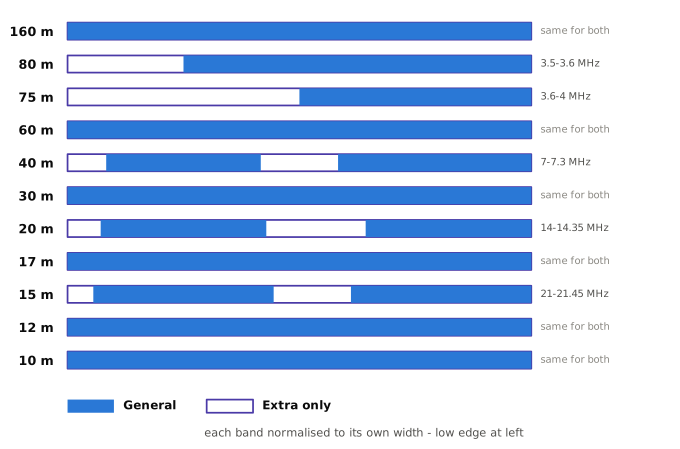
Six of the ten HF bands are identical for General and Extra: 160, 60, 30, 17, 12, and 10 metres. On those, a General has everything.
The other four — 80, 40, 20, and 15 metres — have segments reserved for Amateur Extra. Those are the same four bands the pool asks about, twice:
On which HF and/or MF amateur bands are there portions where General class licensees cannot transmit?
80 meters, 40 meters, 20 meters, and 15 meters
Which HF bands have segments exclusively allocated to Amateur Extra licensees?
80 meters, 40 meters, 20 meters, and 15 meters
Same four bands, same answer, asked from both directions.
The rule that predicts the boundaries
When General class licensees are not permitted to use the entire voice portion of a band, which portion of the voice segment is available to them?
The upper frequency portion
Extra gets the bottom; General gets the top. That single sentence generates the phone boundaries:
| Band | General phone | Extra phone starts at |
|---|---|---|
| 75 m | 3.800 – 4.000 MHz | 3.600 |
| 40 m | 7.175 – 7.300 MHz | 7.125 |
| 20 m | 14.225 – 14.350 MHz | 14.150 |
| 15 m | 21.275 – 21.450 MHz | 21.200 |
If you remember only “General gets the upper part,” you can reconstruct which of two frequencies is available without recalling the exact number.
A worked example the pool asks: is 21300 kHz in the General portion of 15 metres? 21300 kHz is 21.300 MHz, which is above 21.275 — yes.
The 40 metre gap
One boundary does not follow the pattern, and the pool asks it directly.
On which of the following frequencies are General class licensees prohibited from operating as control operator?
7.125 MHz to 7.175 MHz
The General 40 metre allocation is in two pieces — 7.025 to 7.125, then 7.175 to 7.300 — with a 50 kHz Extra-only gap between them. It is the only band where a General allocation is interrupted rather than merely truncated, and it is worth memorising as a special case.
The two bands with unusual rules
30 metres (10.100 – 10.150 MHz) is the odd one out:
On which of the following bands is phone operation prohibited?
30 meters
On which of the following bands is image transmission prohibited?
30 meters
CW and data only. Thirty metres is a narrow band shared with fixed services worldwide, and voice would swamp it.
10 metres is the most generous:
On which amateur frequencies in the 10-meter band may stations with a General class control operator transmit CW emissions?
The entire band — meaning the entire phone portion, 28.300 to 29.700 MHz.
And it is the only HF band with repeaters:
What portion of the 10-meter band is available for repeater use?
The portion above 29.5 MHz.
Primary and secondary
Which of the following applies when the FCC rules designate the amateur service as a secondary user on a band?
Amateur stations must not cause harmful interference to primary users and must accept interference from primary users
Both halves matter. You must not interfere with the primary service, and you have no protection from it. On 60 metres and parts of 30 metres, hearing a non-amateur station means moving.
The habit
Before transmitting on a new band, ask three questions:
- Which segment am I in — does this band have an Extra-only portion, and am I above it?
- What emissions are permitted here — 30 metres is CW and data only.
- Am I primary or secondary — and if secondary, am I prepared to move?
Check yourself
- Is 14.200 MHz available to a General for phone?
- You want to work SSB on 40 metres. What is the lowest frequency you may use?
- Why is a General not permitted to use phone on 30 metres?
Answers
- No. General phone on 20 metres starts at 14.225 MHz; 14.200 is in the Extra-only portion.
- 7.175 MHz. The General allocation resumes there after the 7.125–7.175 gap, and phone begins at the same point.
- Phone is prohibited on 30 metres for everyone. It is a narrow band shared with fixed services, restricted to CW and data.