Rectification
A rectifier turns AC into DC by letting current through in one direction only. How much of the AC cycle it uses is the distinction the pool tests.
| Circuit | Diodes | Cycle converted | Output ripple |
|---|---|---|---|
| Half-wave | one | 180 degrees | at the input frequency |
| Full-wave (centre-tapped) | two + centre-tapped transformer | 360 degrees | twice the input frequency |
| Full-wave bridge | four | 360 degrees | twice the input frequency |
Which type of rectifier circuit uses two diodes and a center-tapped transformer?
Full-wave.
What is characteristic of a half-wave rectifier in a power supply?
Only one diode is required.
What is the output waveform of an unfiltered full-wave rectifier connected to a resistive load?
A series of DC pulses at twice the frequency of the AC input.
That doubling is the whole advantage: ripple at 120 Hz rather than 60 Hz is twice as easy to filter, so the same smoothing needs half the capacitance.
Filtering
Which of the following components are used in a power supply filter network?
Capacitors and inductors.
A capacitor across the output resists changes in voltage; an inductor in series resists changes in current. Together they form a low-pass filter that passes DC and blocks ripple — the reactance lesson applied to a practical problem.
What is the function of a power supply bleeder resistor?
It discharges the filter capacitors when power is removed.
The safety component from the foundations lesson, named. A large filter capacitor holds a lethal charge after switch-off; the bleeder drains it over some seconds.
And it fails open silently. A supply with a failed bleeder works perfectly and is lethal. Which is why the rule is unplug, wait, and verify with a meter — never trust the bleeder.
Switchmode supplies
Which of the following is characteristic of a switchmode power supply as compared to a linear power supply?
High-frequency operation allows the use of smaller components.
Transformer and filter size scale inversely with frequency. Switching at 100 kHz rather than 60 Hz shrinks the magnetics enormously — which is why a modern 30 A supply is a small light box rather than a heavy one.
The cost is RF noise. A switching supply generates broadband hash at its switching frequency and every harmonic, and a badly filtered one is a station-wide noise source. This is the most common cause of “my noise floor went up and I do not know why.”
Figure G7-1
Five symbols the pool asks about, and this figure appears in several General questions.
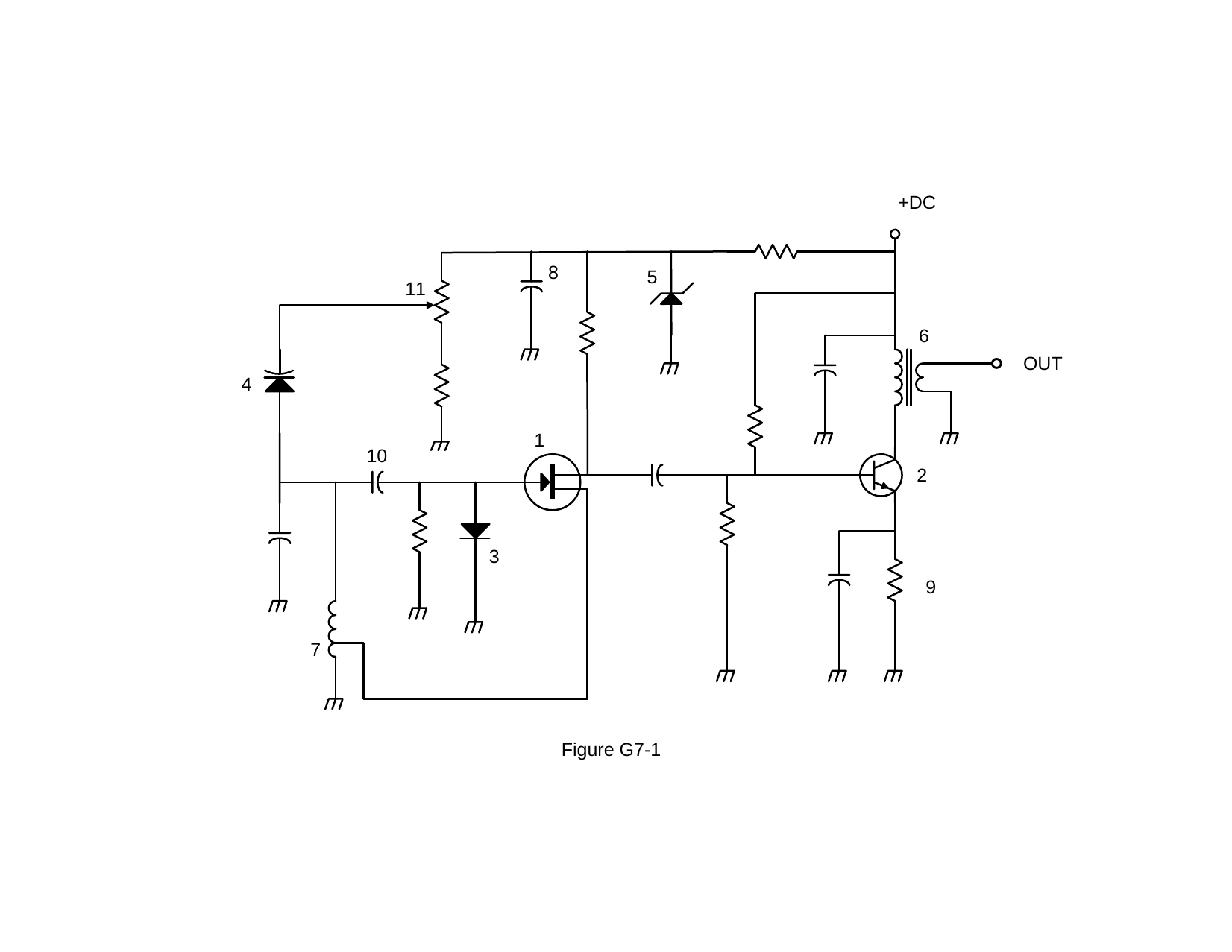
| Symbol | What it is |
|---|---|
| 1 | Field effect transistor |
| 2 | NPN junction transistor |
| 5 | Zener diode |
| 6 | Solid core transformer |
| 7 | Tapped inductor |
The distinctions worth learning rather than memorising by number:
- FET versus bipolar — a bipolar transistor’s symbol has an arrow on the emitter (pointing out for NPN, in for PNP); a FET has a flat gate bar and no emitter arrow.
- Zener versus ordinary diode — a Zener’s cathode bar is bent at the ends, like a Z. It is drawn reverse-biased in circuit, because that is how it is used: as a voltage reference at its breakdown voltage.
- Solid core versus air core transformer — bars between the windings mean a core; nothing between them means air.
- Tapped inductor — a connection partway along the coil, which is how a single winding provides several inductance values or an impedance transformation.
Check yourself
- Your unfiltered supply shows ripple at 120 Hz from a 60 Hz mains input. Half-wave or full-wave?
- Your noise floor rose after you replaced a heavy linear supply with a light modern one. Likely cause?
- Why is “the bleeder resistor will have discharged it” not a safe assumption?
Answers
- Full-wave — it converts the whole 360 degrees, producing pulses at twice the input frequency.
- Switchmode noise. Switching supplies generate broadband hash; a poorly filtered one raises the noise floor across HF.
- A bleeder fails open silently. The supply works normally and the capacitors stay charged. Verify with a meter.