Your dial reads the carrier, not your signal
This is the single most-tested idea in Extra rules, and it catches people who have operated legally for years by luck.
A transceiver displays the suppressed carrier frequency. Your actual emission occupies about 3 kHz on one side of that number — above it for USB, below it for LSB. The band edge applies to the emission, not to the dial.
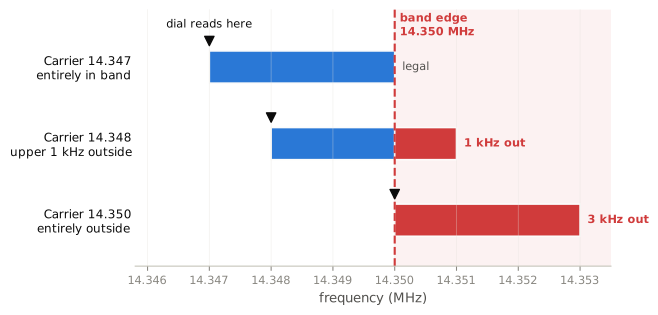
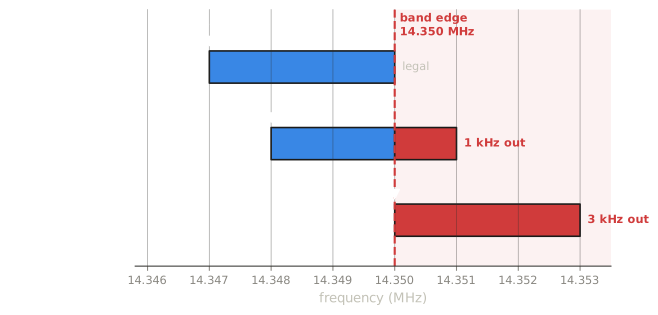
Why is it not legal to transmit a 3 kHz bandwidth USB signal with a carrier frequency of 14.348 MHz?
The upper 1 kHz of the signal is outside the 20-meter band.
Work it: 14.348 + 0.003 = 14.351 MHz. The 20 metre band ends at 14.350. The top 1 kHz of your signal is out of band.
When using a transceiver that displays the carrier frequency of phone signals, which of the following displayed frequencies represents the lowest frequency at which a properly adjusted LSB emission will be totally within the band?
3 kHz above the lower band edge.
LSB extends downward, so the carrier must sit a full bandwidth above the lower edge. The two cases are mirror images:
| Mode | Emission occupies | Safe carrier range |
|---|---|---|
| USB | carrier → carrier + 3 kHz | up to upper edge − 3 kHz |
| LSB | carrier − 3 kHz → carrier | from lower edge + 3 kHz |
What is the highest legal carrier frequency on the 20-meter band for transmitting a 2.8 kHz wide USB data signal?
14.1472 MHz.
The 20 metre data segment ends at 14.150 MHz, and USB extends upward:
Note it is the data segment edge, not the band edge — a data emission must stay inside the segment where data is authorised.
May an Extra class operator answer the CQ of a station on 3.601 MHz LSB phone?
No, the sideband components will extend beyond the edge of the phone band segment.
The 75 metre phone segment for Extra begins at 3.600 MHz. LSB at 3.601 extends down to 3.598 — 2 kHz outside. The station calling CQ there is operating illegally, and answering does not make it legal for you.
The rule to carry away: leave a full bandwidth of margin at every segment edge.
Sixty metres — channels and a band
What is the required transmit frequency of a CW signal for channelized 60 meter operation?
At the center frequency of the channel.
Sixty metres is a secondary allocation shared with federal users, and it is the one place in Part 97 where you are given discrete channels rather than a band with edges. Read §97.303(h)(3) and it is actually both:
| Where | Power | |
|---|---|---|
| Four discrete channels | centres 5332.0, 5348.0, 5373.0, 5405.0 kHz | 100 W ERP |
| One 15 kHz band | 5351.5 – 5366.5 kHz | 9.15 W ERP |
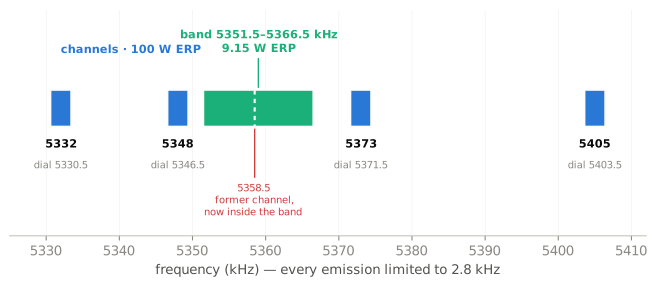
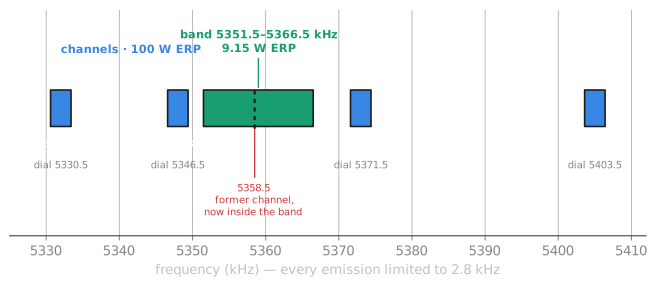
This is the part most study material still gets wrong. For years there were five channels; the WRC-15 allocation absorbed the old 5358.5 kHz channel into a contiguous band, and the regulation now grants four channels plus that band. The pool question still says “channelized”, and it is still right about the channels — but “60 metres is five channels” is out of date.
Three rules, straight from the section:
- CW (emission 150HA1A) sets its carrier on the centre frequency, so the signal sits symmetrically in the channel. That is the pool answer.
- Phone, data, and RTTY (2K80J3E, 2K80J2D, 60H0J2B) may set the carrier 1.5 kHz below the centre — so a USB emission extending upward ends up centred. The dial frequencies are therefore 5330.5, 5346.5, 5371.5, and 5403.5 kHz.
- No emission anywhere on 60 m may occupy more than 2.8 kHz.
Note ERP, and note that §97.313(i) says ERP here is computed against a half-wave dipole, not an isotropic radiator. Feed a dipole 100 W and you are at the channel limit.
The LF and MF bands
Two very low-frequency bands with power limits expressed unusually. §97.313(k) and (l) each set two limits, and both bind:
| Band | Radiated | Transmitter |
|---|---|---|
| 2200 m (135.7–137.8 kHz) | 1 W EIRP | 1.5 kW PEP |
| 630 m (472–479 kHz) | 5 W EIRP | 500 W PEP |
What is the maximum power permitted on the 2200-meter band?
1 watt EIRP (equivalent isotropic radiated power).
Except in some parts of Alaska, what is the maximum power permitted on the 630-meter band?
5 watts EIRP (equivalent isotropic radiated power)
EIRP, not transmitter output — that is what the pool is testing. At these wavelengths any practical antenna is electrically tiny and radiates a small fraction of what you feed it, so a station legally at 1 W EIRP may be running far more than a watt into the antenna. The limit is on what actually leaves, which is the only quantity that matters to the incumbent power-line carrier users.
But do not over-learn that. The transmitter-power ceiling is still there, and on 630 m it is a low one: 500 W PEP, whatever your antenna efficiency works out to.
The Alaska exception is narrower than “parts of Alaska” suggests: stations in Alaska within 800 km of the Russian Federation are held to 1 W EIRP on 630 m.
One more limit that is easy to miss, because it is filed under antennas rather than power — §97.15(c): an antenna transmitting on 2200 m or 630 m must not exceed 60 metres above ground level. At a 630 metre wavelength that is barely a tenth of a wave, which is precisely why efficiency is so low and why the limits are written as EIRP in the first place.
In what portion of the 630-meter band are phone emissions permitted?
The entire band.
Aboard ships and aircraft
If an amateur station is installed aboard a ship or aircraft, what condition must be met before the station is operated?
Its operation must be approved by the master of the ship or the pilot in command of the aircraft
What licensing is required when operating an amateur station aboard a US-registered vessel in international waters?
Any FCC-issued amateur license.
Who must be in physical control of the station apparatus of an amateur station aboard any vessel or craft that is documented or registered in the United States?
Any person holding an FCC issued amateur license or who is authorized for alien reciprocal operation.
The vessel’s registration carries FCC jurisdiction with it, so a US-registered ship in international waters is FCC territory. But the master or pilot in command has absolute authority over what operates aboard — a safety rule that overrides your licence entirely.
Message forwarding
If a station in a message forwarding system inadvertently forwards a message that is in violation of FCC rules, who is primarily accountable for the rules violation?
The control operator of the originating station.
Responsibility follows the origin. A store-and-forward system cannot inspect every message, so the rules place primary accountability on whoever put it into the system — not on the relaying stations. A forwarding station that knowingly passes a violation is a different matter, but the default is the originator.
Check yourself
- You want to run USB data 2.8 kHz wide, ending exactly at the top of the 20 m data segment. What carrier frequency?
- Someone tells you their 630 m station runs 400 watts to the antenna. Are they necessarily violating the rules? What if they said 700 watts?
- You are a licensed amateur flying as a passenger and want to operate. What do you need?
- You want to work CW on 5358.5 kHz. Which of the two 60 m regimes are you in, and what is your power limit?
Answers
- 14.1472 MHz — 14.150 minus 2.8 kHz, because USB extends upward.
- 400 W: not necessarily. The 630 m radiated limit is 5 W EIRP, and an electrically small antenna at 475 kHz radiates a tiny fraction of what you feed it, so 400 W in can still be under 5 W out. 700 W: yes, definitely — §97.313(l) caps 630 m transmitter power at 500 W PEP regardless of antenna efficiency.
- Approval from the pilot in command, in addition to your licence. Their authority over the aircraft is absolute.
- 5358.5 kHz sits inside 5351.5–5366.5 kHz, so you are in the band, not on a channel — the limit is 9.15 W ERP, not 100 W. This used to be a channel, and it is the change most study material has not caught up with.