Elevation angle decides hop length
What effect does lowering a signal’s transmitted elevation angle have on ionospheric HF skip propagation?
The distance covered by each hop increases
Geometry: a shallower angle strikes the ionosphere further away and comes down further still. This is the mechanism behind everything the General antennas module said about antenna height, and it is why a DX antenna is judged by its takeoff angle rather than its gain figure.
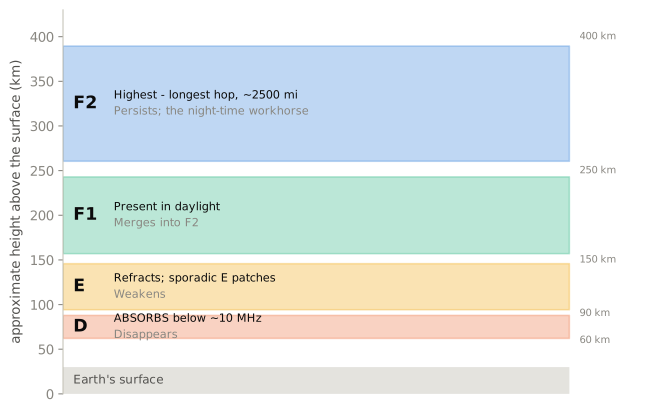
Every path in this lesson is a consequence of those altitudes. A refraction from F2 at 300 km reaches much further than one from E at 100 km, and a chordal hop stays inside the F region rather than descending between refractions.
Transequatorial propagation
Where is transequatorial propagation (TEP) most likely to occur?
Between points separated by 2,000 miles to 3,000 miles over a path perpendicular to the geomagnetic equator
What is the approximate maximum range for signals using transequatorial propagation?
5,000 miles.
At what time of day is transequatorial propagation most likely to occur?
Afternoon or early evening.
Roughly equal distances either side of the magnetic equator, in the late afternoon. TEP works at frequencies well above the ordinary MUF — it regularly opens 6 metres between the Americas and Europe when nothing else is moving — because the equatorial ionosphere is unusually dense and structured.
Chordal hop
What is chordal-hop propagation?
Successive ionospheric refractions without an intermediate reflection from the ground.
What is the effect of chordal-hop propagation?
The signal experiences less loss compared to multi-hop propagation, which uses Earth as a reflector
Ordinary multi-hop bounces off the ground between ionospheric refractions, and each ground reflection costs several decibels. Chordal hop skims along inside the ionosphere, refracting repeatedly without ever touching down — so the losses simply do not occur.
This is why some very long paths are far stronger than a hop count would predict, and it is closely related to TEP.
Long path
Which of the following paths is most likely to support long-distance propagation on 160 meters?
A path entirely in darkness
On which of the following amateur bands is long-path propagation most frequent?
40 meters and 20 meters
A darkness path has no D-region absorption anywhere along it, so the low bands carry worldwide. The long way round is often entirely dark when the short way is not — which is exactly when long path opens.
Forty and twenty are the bands where it is common: high enough to escape the worst absorption, low enough that the MUF supports the distance.
Ground wave
What type of polarization is supported by ground-wave propagation?
Vertical.
How does the maximum range of ground-wave propagation change when the signal frequency is increased?
It decreases
Ground wave follows the Earth’s curvature by dragging along a conductive surface, which only works for a vertically polarised wave — a horizontal one is shorted out by the ground. And higher frequencies attenuate faster, which is why AM broadcast at 1 MHz has a useful ground wave and 28 MHz effectively does not.
Ordinary and extraordinary waves
What are “extraordinary” and “ordinary” waves?
Independently propagating, elliptically polarized waves created in the ionosphere
The Earth’s magnetic field makes the ionosphere birefringent: a single incoming wave splits into two components that propagate independently, with different velocities, different absorption, and opposite senses of elliptical polarisation.
They arrive at slightly different times and combine unpredictably — which is a large part of why HF signals fade the way they do, and why the General track’s answer that “either polarisation works on HF” is true. Whatever you transmit, the ionosphere re-sorts it.
Sporadic E, timed
At what time of year is sporadic-E propagation most likely to occur?
Around the solstices, especially the summer solstice.
At what time of day is sporadic-E propagation most likely to occur?
Between sunrise and sunset.
Summer, daytime — with a well-known secondary peak around the winter solstice. The Technician track said “usually early summer”; this is the precise version, and it tells a 6 metre operator when to be listening.
Check yourself
- Why is chordal-hop propagation stronger than multi-hop over the same distance?
- It is 3 pm and you are 2,500 miles north of the magnetic equator, hoping to work someone 2,500 miles south of it on 6 metres. What mode of propagation?
- Why does ground wave need a vertical antenna?
Answers
- It refracts within the ionosphere without ground reflections, and each ground reflection in multi-hop costs several decibels.
- Transequatorial propagation — the right geometry, the right distance, and the right time of day.
- Ground wave propagates by following a conductive surface, which only works for a vertically polarised wave; a horizontal one is shorted by the ground.