Six diodes, six properties
Each specialised diode exists because one property of a PN junction was exaggerated or exploited.
| Diode | Key property | Use |
|---|---|---|
| Zener | constant voltage drop under varying current | voltage reference |
| Schottky | lower forward voltage drop; metal-semiconductor junction | VHF/UHF mixer or detector; efficient rectifier |
| Varactor | capacitance varies with reverse bias | voltage-controlled capacitance |
| PIN | low junction capacitance | RF switch, attenuator |
| Point-contact | very low capacitance, tiny junction | RF detector |
| LED | band gap sets the forward voltage | light |
What is the most useful characteristic of a Zener diode?
A constant voltage drop under conditions of varying current.
That is what makes a reference: the current through it can wander and the voltage across it barely moves.
Which characteristic of a Schottky diode makes it a better choice than a silicon junction diode for use as a power supply rectifier?
Lower forward voltage drop
Which of the following is a Schottky barrier diode?
Metal-semiconductor junction.
No P-type material at all — metal against semiconductor. The result is roughly 0.3 V of drop instead of 0.7, and essentially no charge storage, so it switches extremely fast. Both properties matter:
Which of the following is a common use of a Schottky diode?
As a VHF/UHF mixer or detector.
Fast switching means it still behaves as a diode at frequencies where an ordinary silicon junction has become a capacitor.
What type of semiconductor device is designed for use as a voltage-controlled capacitor?
Varactor diode.
The depletion-region capacitance from the previous lesson, used deliberately. It is what tunes a PLL’s VCO and what a reactance modulator varies to produce FM.
What characteristic of a PIN diode makes it useful as an RF switch?
Low junction capacitance.
A PIN diode has an intrinsic layer between P and N, which lowers its capacitance so that when it is off, it is genuinely off at RF — an ordinary diode’s junction capacitance would let the signal straight through.
What is used to control the attenuation of RF signals by a PIN diode?
Forward DC bias current.
At RF a forward-biased PIN behaves as a current-controlled resistor, so a DC bias sets an RF attenuation. That is a genuinely useful trick: an electronically variable attenuator with no moving parts, used in every AGC-controlled front end.
What property of an LED’s semiconductor material determines its forward voltage drop?
Band gap.
The band gap sets both the photon energy — hence the colour — and the forward voltage. That is why a blue LED drops around 3 V and a red one around 1.8: same physics, read two ways.
What is a common use for point-contact diodes?
As an RF detector.
A tiny metal whisker on a semiconductor, so almost no junction capacitance. The original crystal-set detector, and still used where extremely low capacitance matters more than robustness.
What kills a diode
What causes a junction diode to fail from excessive current?
Excessive junction temperature.
Not the current itself — the heat it produces at the junction. Which is why datasheets specify maximum junction temperature and thermal resistance, and why a diode’s current rating depends entirely on how well it is heat-sunk.
The same logic as the pass transistor in the regulators lesson: current is only dangerous through the heat it makes.
Figure E6-2
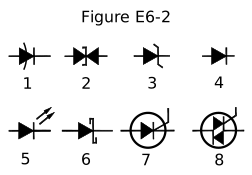
In Figure E6-2, which is the schematic symbol for a Schottky diode?
6
The specialised diodes all modify the plain diode’s cathode bar:
- Zener — bar bent at both ends, like a Z.
- Schottky — bar drawn as a square-cornered S.
- Varactor — a capacitor symbol added alongside the bar.
- Tunnel — bar with a different distinctive bend.
The triangle-and-bar is always there; the bar’s decoration says which kind.
Check yourself
- You need a mixer diode for 432 MHz. Which type, and why?
- What would you use to build an electronically variable RF attenuator?
- Why do a red and a blue LED have different forward voltages?
Answers
- Schottky — a metal-semiconductor junction with low forward drop and no charge storage, so it still switches at UHF.
- PIN diodes, whose RF resistance is set by forward DC bias current.
- Different band gaps — which set both the photon energy (colour) and the forward voltage.